
Sleep to Live a Long and Healthy Life (and Why Your Best Health Plan Starts at Night)
If you’ve been treating sleep like the “nice-to-have” that gets squeezed in after everything (and everyone) else, I want to lovingly interrupt that narrative: sleep is not a luxury. Sleep is biology. It’s the nightly reset that helps you live longer and live better—because it’s when your body does the work it cannot do as effectively while you’re awake.
That’s exactly why I was invited to share sleep and longevity education on Live with Kelly and Mark during their “A Simple Fix for ’26” week. The video is embedded below as an additional way to consume the message—then this article breaks it down in a clear, compassionate, evidence-aligned way you can actually use.
Sleep is power. Sleep is your superpower. And if you’ve been surviving on “fine,” I want you to know: feeling under-recovered is not your personality—it’s a signal. Let’s talk about what your body is trying to do at night, why so many people feel like their sleep is getting worse, and how to build sleep that holds up in real life.
What sleep is actually doing for longevity (this is the part most people underestimate)
When you sleep, your body isn’t “shutting down.” It’s switching gears—from performance mode to repair mode. Sleep gives your heart and lungs a chance to rest. It supports your immune system. It’s a key window for hormones to reset. And yes, your brain uses sleep as a critical time to do its own maintenance—what I described in the segment as your brain essentially “cleaning itself out.” (If you want the science behind this “nighttime brain cleanup,” here’s a foundational paper.
This matters because so many people tell me the same thing: “I slept, but I woke up feeling foggy.” That experience is often what fragmented or under-restorative sleep feels like. You may be in bed for the right number of hours, but if your sleep is too light, too broken up, or too stressed, you can wake up feeling like your brain never fully powered down.
Longevity isn’t just about adding years. It’s about preserving your clarity, your resilience, and your ability to feel good in your body. Sleep supports all of that. When your sleep is consistently disrupted, your whole system has to work harder—your brain, your mood, your energy, your recovery capacity. That’s why I’m so direct about this: sleep isn’t optional if you want to optimize your health.
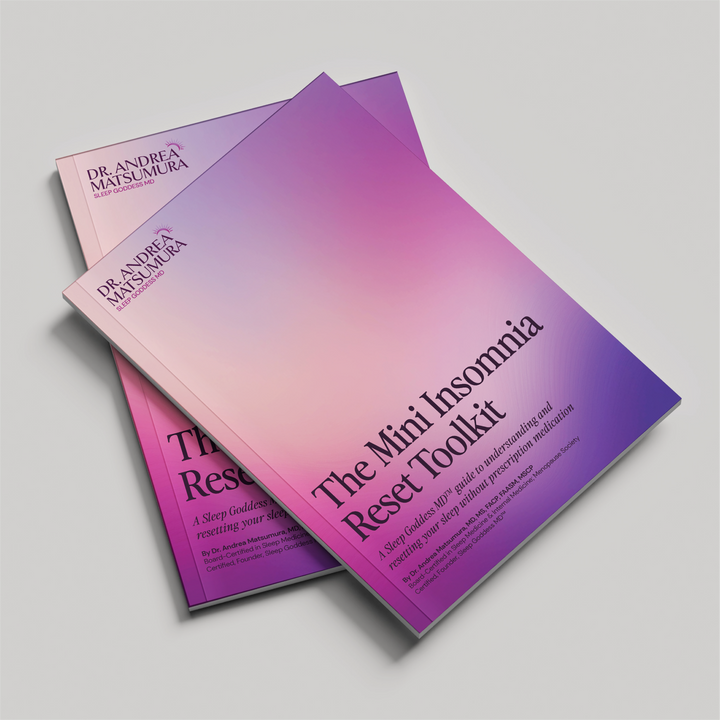
The Mini Insomnia Reset Toolkit
If you are exhausted from lying awake at night, waking up at 2 to 4 a.m. with a racing mind, or dreading bedtime because you do not trust your body to sleep, you are not alone. Millions of women in midlife experience insomnia, yet most are left navigating it in silence, feeling broken and defeated.
Why insomnia and “bad sleep” are rising (and why it’s not because you’re failing)
There are a lot of reasons sleep can become more fragile, but two modern culprits show up again and again:
1) We spend a lot of time on our phones.
Scrolling late at night is incredibly common and it tends to keep the brain stimulated at the exact time you’re asking it to downshift. Sleep is not just a decision. It’s a physiological state. If we keep feeding the brain novelty, information, bright light, and emotion right up until bedtime, we make sleep harder to access.
2) Chronic stress keeps the nervous system “on.”
When your body is carrying a heavy stress load, sleep often becomes lighter and more fragmented. That’s when people describe the “wired but tired” feeling: exhausted, but not settled. Sleep is easier when the body feels safe. And modern life doesn’t always deliver that signal.
So if your sleep has started to feel unpredictable, inconsistent, or increasingly shallow—this is your reminder: you’re not broken. Your physiology is responding to your environment. The good news is that physiology can be supported. And the first step is understanding what sleep actually looks like (because many people are interpreting their sleep data in a way that scares them unnecessarily).
If the specific pattern you’re dealing with is waking up in the middle of the night (hello, 2–4 a.m.), check out our article on Waking Up in the Middle of the Night: Why It Happens and How to Stay Asleep.
Sleep stages, explained without the spiral (and why “light sleep” isn’t automatically bad)
One of the most important misconceptions I see right now is the idea that if your tracker labels something as “light sleep,” you didn’t get real sleep. That’s not true.
There are different stages of sleep, and you will naturally move through them throughout the night. In the segment, we talked about:
- Light sleep (which includes the earlier stages as you drift in)
- Stage 2 sleep (a major portion of many people’s nights)
- Deep sleep, where “most of the repair happens”
- REM sleep, which matters for brain function and how you feel the next day
Here’s what I want you to remember: your sleep doesn’t always go in perfect order. People often assume sleep moves in a neat sequence like a staircase: Stage 1, Stage 2, deep sleep, REM, repeat. In real life, it can be more dynamic. You can transition into REM sleep from Stage 2 sleep. So no, you don’t need to lie awake worrying that your sleep stages are “doing it wrong.” Your brain is allowed to be a brain.
Deep sleep is the phase I emphasized most in relation to repair—this is also where we often talk about the glymphatic system being active (a system involved in the brain’s nighttime housekeeping). That said, it’s not a contest where deep sleep is “good” and everything else is “bad.” Healthy sleep is a rhythm. It’s cycling. It’s consistency.
And this is exactly where wearable tech can either help you or harm you.
The Mini Insomnia Reset Toolkit
If you are exhausted from lying awake at night, waking up at 2 to 4 a.m. with a racing mind, or dreading bedtime because you do not trust your body to sleep, you are not alone. Millions of women in midlife experience insomnia, yet most are left navigating it in silence, feeling broken and defeated.
Wearables can be useful… until they start priming you to feel worse
If you’ve ever woken up feeling okay, checked your tracker, and suddenly thought, “Oh no. I slept terribly,” you’re not alone. This is what I mean when I say wearables can “prime” people.
You know yourself best. And your lived experience matters.
Before you look at your data, pause and ask: How do I feel?
Because if the device is turning sleep into a performance metric; something you chase, perfect, and fear—you may actually be increasing sleep anxiety. Sometimes the most supportive move is simpler than people expect: stop looking at it. Not forever, not dramatically. Just enough to rebuild trust in your body.
Sleep is not a grade. It’s a physiological process. The goal is not perfect data. The goal is restorative, reliable sleep that supports your waking life.
How much sleep do you need—and what the new conversation is really about
You’ll often hear the general guideline that most adults need 7–9 hours of sleep. That’s a helpful starting frame. But the more important point—and the one I emphasized in the segment—is that the conversation is increasingly shifting toward consistency and quality.
It’s also worth knowing that this isn’t just a wellness opinion—it’s reflected in major public health and sleep medicine guidance. The American Academy of Sleep Medicine and Sleep Research Society recommend adults get 7 or more hours per night on a regular basis for optimal health.
The CDC’s sleep guidance echoes that baseline as well.
Because you can be in bed for eight hours and still wake up foggy if your sleep is fragmented. And you can sometimes function better on a slightly shorter night if your sleep is stable and restorative. Your body isn’t only tracking “hours.” It’s tracking rhythm.
This is where the least glamorous advice is often the most effective:
Go to bed at the same time and wake up at the same time.
People always say, “Yeah, yeah, I do that.” And I get it—life is real. But consistency is one of the strongest signals you can give your circadian system. It teaches your brain when to expect sleep and when to expect wakefulness. It’s not sexy, but it’s foundational.
If you want a “simple fix” that actually supports longevity, start with rhythm.
Why women are often more vulnerable to insomnia (and why you deserve better than dismissal)
Women tend to be more vulnerable to insomnia and sleep disruption, and in the segment we named two big drivers:
- Hormones, which can affect sleep regulation across the lifespan
- Psychosocial factors, which can create chronic strain on the nervous system and wreck sleep quality
If you’re in a season of life where sleep feels more fragile, more sensitive, or more easily disrupted, please hear this clearly: you’re not imagining it. And you also don’t deserve to be brushed off.
This is why I’m so committed to being a trained, fact-driven guide in this space—because women deserve sleep-literate care and strategies designed for real physiology, not generic advice that ignores context.
The Mini Insomnia Reset Toolkit
If you are exhausted from lying awake at night, waking up at 2 to 4 a.m. with a racing mind, or dreading bedtime because you do not trust your body to sleep, you are not alone. Millions of women in midlife experience insomnia, yet most are left navigating it in silence, feeling broken and defeated.
Napping: when it helps, when it backfires, and what I recommend
Napping is one of those topics that’s deeply personal. Some people feel amazing after a short nap; others wake up groggy and worse than before. In the segment, the question came up in a very real way—someone saying they feel better if they nap for under 45 minutes.
Here’s the general recommendation I gave: a 20-minute nap.
A short nap can take the edge off sleepiness and support alertness without pulling you too deep into sleep stages that can cause sleep inertia (that heavy, foggy feeling after waking). The key is keeping it short and strategic—especially if you’re trying to protect nighttime sleep consistency.
Your sleep environment should be doing half the work for you
If you want quick wins that support better sleep without overhauling your life, start here. Your room should be:
dark, cool, and quiet.
Not “dim.” Dark.
Not “comfortable.” Cool.
Not “mostly quiet.” Quiet.
And yes—this is where I said it plainly: snoring counts as noise. If snoring (yours or a partner’s) is disrupting sleep, it’s worth addressing, because noise and sleep fragmentation are not neutral. They can keep the brain from dropping fully into the restorative depth it needs.
If snoring has become part of your sleep story, especially in midlife, this is an important next read.
If you do nothing else, make your bedroom a cue for downshifting. Your environment is one of the most underrated sleep tools you have.
“Sleep tools” aren’t one-size-fits-all—because adults need training too
There are a lot of sleep tools out there. And people want me to name the one that will “fix” it. But the truth is: there isn’t one universal tool that works for everyone.
What does work is learning how to support your sleep system—and practicing it long enough that your body trusts the pattern.
We train kids. We train pets. Then we forget about ourselves.
As adults, we often have to train ourselves to sleep again. That might mean building consistency, adjusting timing, protecting your environment, reducing stimulation at night, or choosing targeted supports that fit your physiology. The right tool is the one that you can actually sustain, and that helps your body feel safe enough to sleep deeply.
If you want a structured, midlife-specific roadmap that pulls all of this together, read this next.
And yes—melatonin came up too, because it always does. My honest answer is the same: melatonin is a big topic, and it deserves a separate, nuanced conversation. (If you’ve been confused by melatonin, you’re not alone. And you don’t need to keep guessing.)
The takeaway: sleep is your superpower—and you can reclaim it
If you’ve been living in survival sleep—pushing through, performing, functioning, getting by—consider this your permission slip to take sleep seriously again. Not in an anxious, perfectionistic way. In a powerful, grounded way.
Start with consistency. Protect your environment. Use data wisely (or not at all, if it’s making you spiral). Keep naps short and strategic. And remember: sleep is not something you force. It’s something you support.
Sleep is power. Sleep is your secret weapon. Sleep is your superpower—and you deserve to live out your waking dreams with a body that’s actually recovered enough to do it.
The Mini Insomnia Reset Toolkit
If you are exhausted from lying awake at night, waking up at 2 to 4 a.m. with a racing mind, or dreading bedtime because you do not trust your body to sleep, you are not alone. Millions of women in midlife experience insomnia, yet most are left navigating it in silence, feeling broken and defeated.