
For so many women in midlife, sleep becomes unpredictable: you’re exhausted, yet your mind won’t settle. Or you fall asleep easily, only to wake up at 2 or 3 a.m. with your thoughts racing, your heart pounding, or your body drenched in heat. And when you bring it up to your provider, you may hear: “That’s just menopause.”
But sleep disruption in midlife is not something you simply “have to live with.”
It has real causes — and real solutions.
Dr. Andrea with Cynthia Thurlow on the Everyday Wellness Podcast
I recently joined Cynthia Thurlow on the Everyday Wellness Podcast to pull back the curtain on what’s really happening to women’s sleep in perimenopause and menopause — and why it’s not your fault. Our conversation dug into hormones, breath mechanics, orthosomnia, wearables, the hidden epidemic of sleep apnea in women, and the real path toward restoring deep, reliable sleep.
As a Sleep Medicine Physician, Menopause Specialist, and creator of the D.R.E.A.M. Sleep Method™, I believe every woman deserves evidence-backed guidance, honest conversation, and the tools to reclaim her sleep superpower.
This guide breaks everything down in a way that is clear, compassionate, and actionable — and rooted in accurate science.
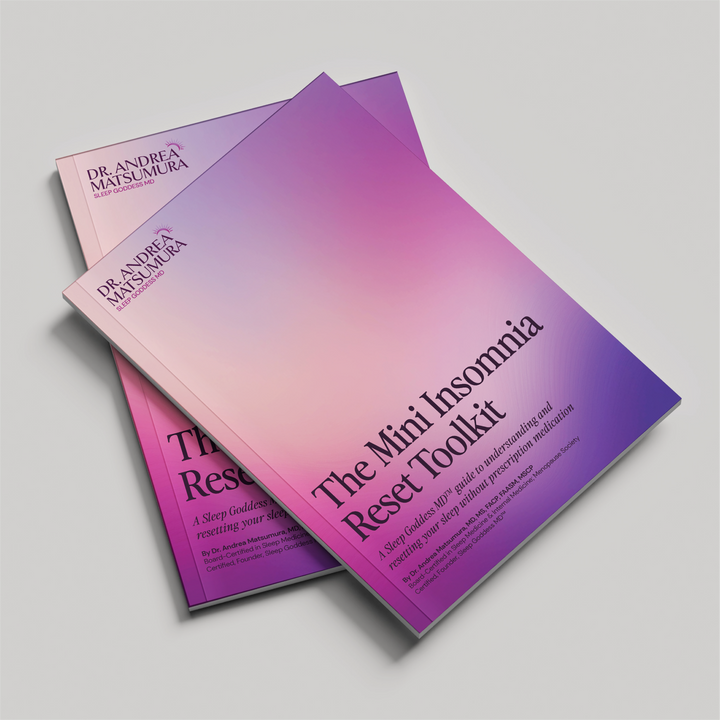
The Mini Insomnia Reset Toolkit
If you are exhausted from lying awake at night, waking up at 2 to 4 a.m. with a racing mind, or dreading bedtime because you do not trust your body to sleep, you are not alone. Millions of women in midlife experience insomnia, yet most are left navigating it in silence, feeling broken and defeated.
Why Sleep Changes in Midlife — And Why You’re Not Imagining It
Hormones don’t just influence mood, metabolism, or hot flashes — they directly shape your sleep architecture, the way your brain cycles through the stages of sleep.
- Progesterone helps you drift into sleep. When it dips, so does your ability to fall asleep.
- Estrogen helps you stay asleep, supports temperature regulation, and helps potentiate REM sleep.
- Testosterone supports slow-wave (deep) sleep.
During perimenopause and menopause, the fluctuation and decline of these hormones can cause:
- Difficulty falling asleep
- Frequent nighttime awakenings
- Early morning waking
- Lighter, less restorative sleep
- Heightened nighttime anxiety
This pattern is extremely common: 40–60% of peri- and postmenopausal women experience significant sleep problems.
Source: Sleep and sleep disorders in the menopausal transition (NIH review)
You’re not imagining the changes — your brain and body are genuinely transitioning.
The Missing Piece: Sleep Apnea in Midlife Women
One of the most eye-opening topics we discussed is the prevalence of sleep apnea in menopausal women — a topic rarely talked about, even in medical settings.
Most people imagine sleep apnea as loud snoring, gasping, or a bed partner shaking you awake. But this stereotype was built on men’s symptoms.
Women look different.
In midlife women, sleep apnea often shows up as:
- Insomnia
- Waking frequently and not knowing why
- Brain fog
- Morning headaches
- Depression or low mood
- Light snoring (more like a hum)
- Fatigue despite “getting 7–8 hours”
And here’s the reality: 47–67% of postmenopausal women may have obstructive sleep apnea.
Source: Obstructive Sleep Apnea: Women’s Perspective
This increase is not due to weight or lifestyle — it’s strongly linked to loss of progesterone, which normally helps keep the airway open during sleep.
Why it remains missed:
- Most screening tools were created using male participants
- Women often present with insomnia rather than sleepiness
- Providers may attribute symptoms to “stress” or “menopause”
This is why women deserve sleep-literate medical care — someone trained to understand the nuances of sleep physiology through the menopause transition.
What Happens When Sleep Is Fragmented? (It’s More Serious Than Feeling Tired)
Poor sleep affects every system in the body.
Research shows:
- Sleep deprivation impairs cognitive function to a level comparable with alcohol intoxication
- Being awake for ~17 hours = cognitive impairment around 0.05% BAC
- Being awake for ~24 hours = impairment around 0.10% BAC
- Source: CDC
- Sleep fragmentation increases risk for:
- Cardiovascular issues
- Memory problems
- Mood changes
- Insulin resistance
- Chronic pain
Why does sleep fragmentation hit midlife women harder?
Because our sleep cycles become more fragile just as hormonal stabilizers decline. Your brain works harder to maintain sleep — and that effort shows up as irritability, anxiety, fogginess, or feeling “wired but tired.”
Wearables Can Help — But They Can Also Hurt
Sleep trackers are useful for spotting trends, but they’re not diagnostic and they’re not always accurate in measuring sleep stages.
They can also trigger orthosomnia — anxiety caused by trying to perfect your sleep data.
Here’s my advice:
Before checking your wearable, ask yourself: “How do I feel?”
Your subjective sleep experience is more accurate than your device’s staging algorithm — especially for women.
Why Sleep Matters for Long-Term Brain Health
Women comprise nearly two-thirds of people with Alzheimer’s disease.
Source: Alzheimer’s Association, 2024 Facts & Figures
One possible contributor?
The age-related decline in melatonin, combined with estrogen loss.
What the research shows:
- The pineal gland naturally calcifies with age
- Calcification is associated with reduced melatonin production
- Reduced melatonin is linked to fragmented sleep and circadian disruption
This does not mean melatonin is a cure-all — but it does mean the sleep/melatonin/menopause triangle is real and deserves attention.
The D.R.E.A.M. Sleep Method™: A Clear, Evidence-Informed Roadmap
Sleep issues in midlife are multifactorial, which is why single-focus advice (“just meditate,” “go to bed earlier,” “use lavender”) is rarely enough.
My D.R.E.A.M. Sleep Method™ addresses the five critical pillars that affect women’s sleep:
D — Daily Habits
Light exposure, caffeine timing, movement, nervous-system regulation.
R — Resting Environment
Temperature, bedding, light exposure, sound, airway positioning.
E — Emotional Factors
Anxiety, stress load, trauma history, nighttime hypervigilance.
A — Archetype
Your circadian rhythm (morning lark, night owl, or balanced).
M — Medical Conditions
Sleep apnea, insomnia, medication effects, hormonal shifts, pain disorders.
This method is designed specifically for women — because our sleep challenges are not the same as men’s.
What Actually Helps (Backed by Strong Evidence)
✔ CBT-I (Cognitive Behavioral Therapy for Insomnia)
The gold-standard, first-line treatment for chronic insomnia.
✔ ACT (Acceptance & Commitment Therapy) for sleep anxiety
Helps remove pressure, fear, and performance anxiety around sleep.
✔ Oral Appliances
Helpful for mild to moderate sleep apnea.
✔ CPAP therapy
The most effective treatment for moderate to severe sleep apnea.
✔ Positional therapy
If apnea worsens on your back, adjusting sleep position can help.
✔ Menopause Hormone Therapy (MHT)
Can improve sleep quality by stabilizing estrogen and progesterone —
but does not cure sleep apnea.
What Doesn’t Work (Long-Term)
✖ Over-the-counter “sleep supplements”
They may help temporarily, but they do not fix insomnia or apnea.
✖ Prescription sleep medications
They sedate you but do not restore natural sleep architecture.
✖ “Trying harder to sleep”
This often makes insomnia worse — sleep is not something you force.
Shift Workers: Your Brain Isn’t “Weak” — Your Schedule Is Misaligned
Shift work creates a mismatch between your biological clock and your working hours.
Strategies that help:
- Wear sunglasses on your way home after a night shift
- Go directly to bed (no chores, no screens)
- Use blackout curtains and an eye mask
- Limit caffeine to the early part of your shift
- Take a 20–30 minute nap BEFORE your night shift to stabilize alertness
Small adjustments can make a big difference.
You Deserve More Than Survival Sleep
You’ve spent years — sometimes decades — caring for others, juggling demands, waking early, staying up late, pushing through your exhaustion.
But your sleep is not a luxury.
It is your clarity.
Your mood.
Your metabolic health.
Your cognitive resilience.
Your longevity.
Your power.
Sleep is your superpower — and you deserve to reclaim it.
With the right evaluation, the right tools, and a method that understands the physiology of midlife women, restorative, reliable sleep is absolutely possible.
The Mini Insomnia Reset Toolkit
If you are exhausted from lying awake at night, waking up at 2 to 4 a.m. with a racing mind, or dreading bedtime because you do not trust your body to sleep, you are not alone. Millions of women in midlife experience insomnia, yet most are left navigating it in silence, feeling broken and defeated.