
4–7–8 Breathing
A simple tool to calm your nervous system and support sleep
If you’re lying in bed with a busy mind, feeling “tired but wired,” or waking in the middle of the night with a surge of anxiety or heat, your body may be stuck in a higher-arousal state than sleep requires. 4–7–8 breathing is a paced breathing technique designed to help your system downshift by activating the parasympathetic nervous system (your body’s “brake pedal”). (Cleveland Clinic)
It’s not a trick or a hack—it’s a nervous system practice. Done consistently, it can reduce physiological arousal, lower sleep-onset anxiety, and help you settle during middle-of-the-night awakenings. (Direct research on 4–7–8 specifically is limited, but the broader research on slow, paced breathing shows meaningful effects on stress physiology and sleep quality.) (British Heart Foundation)
What 4–7–8 breathing is doing in your body
4–7–8 is a structured pattern: inhale (4) → hold (7) → long exhale (8). The most important feature is the slow, controlled exhale, which helps signal safety and calm to the nervous system. Longer exhalations are commonly discussed as one pathway for increasing parasympathetic (vagal) activity and reducing “fight-or-flight” activation. (PMC)
From a sleep perspective, that matters because sleep onset and sleep maintenance are both harder when your body is running “too hot” (mentally or physiologically). Slow, paced breathing has been linked with improvements in insomnia-related outcomes and increased measures of vagal activity/HRV in research settings. (PubMed)
How to do 4–7–8 breathing
Set up (30 seconds): Sit or lie comfortably. Rest your tongue gently on the roof of your mouth just behind the front teeth.
- Exhale fully through your mouth.
- Inhale quietly through your nose for 4 seconds.
- Hold your breath for 7 seconds.
- Exhale slowly through your mouth for 8 seconds.
- That’s one cycle.
- Repeat for 4 cycles to start. (Cleveland Clinic)
Quick start: If you only do one thing, do 4 cycles before bed and keep the exhale slow and smooth.
Tips that make it work better (and feel better)
- The exhale is the most important part. Slow and controlled beats forceful.
- If 4–7–8 feels too long at first, shorten it. You can start with something like 3–5–6 or 4–4–6, then build up over time.
- Mild lightheadedness can happen early on. That can be normal when you change breathing patterns; stop if you feel uncomfortable or dizzy. (Cleveland Clinic)
- Practice once when you’re calm. It’s easier to use during a 2 a.m. wake-up if you’ve done it at least a few times in daylight.
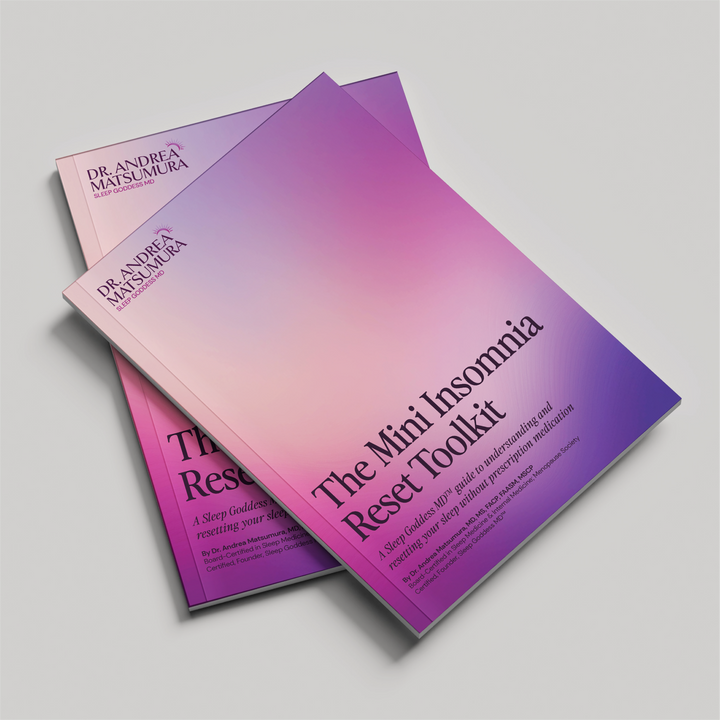
The Mini Insomnia Reset Toolkit
If you are exhausted from lying awake at night, waking up at 2 to 4 a.m. with a racing mind, or dreading bedtime because you do not trust your body to sleep, you are not alone. Millions of women in midlife experience insomnia, yet most are left navigating it in silence, feeling broken and defeated.
When to use it for sleep support
1) Before bed (sleep-onset support)
Use 4–7–8 as part of a wind-down sequence to help reduce mental chatter and signal “it’s safe to sleep.”
2) During nighttime awakenings (especially anxiety or hot-flash arousal)
If you wake with a surge—heart pounding, mind racing—paced breathing can help lower arousal so your body can re-enter sleep more easily.
3) During the day (protecting sleep later)
Daytime stress doesn’t disappear at bedtime. Using paced breathing earlier in the day can help reduce accumulated activation that otherwise shows up as night waking.
Troubleshooting: common issues and fixes
“The breath hold makes me anxious.”
Shorten the hold first (e.g., 4–3–8), then gradually lengthen only if it feels steady.
“I feel more activated after I try it.”
This can happen if you’re unintentionally breathing too forcefully. Make the inhale quieter and the exhale slower. Fewer cycles can be better at first.
“I get dizzy.”
Stop, return to normal breathing, and try again later with shorter counts and fewer cycles. (Cleveland Clinic)
“How long should it take to help?”
Many people feel a shift within a few minutes, but the real benefit comes from consistency—training your nervous system to associate the pattern with settling.
A note on the science (without overclaiming)
- There isn’t a large body of clinical research on 4–7–8 specifically, but slow paced breathing (often around 4.5–6.5 breaths/min in research contexts) has documented effects on autonomic balance and stress regulation. (Nature)
- In insomnia research, paced breathing before sleep has been associated with improvements like reduced sleep onset latency, fewer awakenings, and improved sleep efficiency in controlled studies. (PubMed)
- Mechanistically, slow breathing is commonly linked to increases in vagal activity/HRV and shifts toward parasympathetic dominance—conditions that support sleep readiness. (PubMed)
How 4–7–8 fits into the D.R.E.A.M. Sleep Method™
D — Daily Habits
Use 4–7–8 as a nightly wind-down ritual. Consistency trains your nervous system to associate this breathing pattern with safety and sleep.
R — Resting Environment
Practice in low light, ideally in bed or a calm chair. Pair it with a cool, quiet room to reinforce relaxation signals.
E — Emotions
This technique directly targets emotional arousal, anxiety, and stress reactivity—especially relevant for women whose sleep is disrupted by fluctuating hormones.
A — Archetype (Circadian Rhythm)
Use it in the evening or during nighttime awakenings (rather than first thing in the morning). The goal is to support nighttime parasympathetic dominance.
M — Medical Conditions
Helpful for insomnia, stress-related sleep disruption, and perimenopausal/menopausal sleep issues. It supports—but does not replace—evaluation and treatment for conditions like sleep apnea, restless legs, or severe anxiety disorders.
Sleep Goddess takeaway
4–7–8 breathing isn’t a quick fix—it’s a nervous system practice. When used consistently, it can lower nighttime arousal, shorten the time it takes to fall asleep, and help your body re-learn how to settle during middle-of-the-night awakenings. And when layered into a full sleep system, it tends to work best as part of a method—not as a standalone solution.
Educational use only. Not a substitute for individualized medical care.
The Mini Insomnia Reset Toolkit
If you are exhausted from lying awake at night, waking up at 2 to 4 a.m. with a racing mind, or dreading bedtime because you do not trust your body to sleep, you are not alone. Millions of women in midlife experience insomnia, yet most are left navigating it in silence, feeling broken and defeated.